
Steve Buttry
Steve Buttry, a journalist for more than 45 years, died February 19 at age 62 of pancreatic cancer, his third major cancer.
A memorial service will be held in coming weeks in Minneapolis, Minnesota. Details are pending and will be posted to this blog and other social media platforms. The family requests that memorial tributes are directed to a scholarship fund created in Buttry’s honor at the LSU Manship School of Journalism.
Buttry spent most of his career as a reporter and editor, but achieved prominence late in his career as a newsroom trainer, then as an advocate for and teacher of digital journalism and media innovation and finally for blogging openly about his cancer treatment.
His first cancer, colon cancer, was detected early and was cured by surgery in August 1999, when Buttry was a religion reporter and writing coach for the Des Moines Register. He did not need further treatment, but had a second bowel resection in 2006 after discovery of pre-cancerous lumps in his appendix and lymph nodes near the colon. Buttry joked after the surgeries about having a “semi-colon,” but was able to resume a normal lifestyle.
A second cancer diagnosis, basal-cell skin cancer, required microsurgery in 2005, but needed no further treatment. Buttry didn’t count that among his three major cancers.
In 2014, he was diagnosed with Stage IV mantle-cell lymphoma. That was cured by six rounds of heavy-duty chemotherapy, followed by a stem-cell transplant, using Buttry’s own stem cells.
In a 2014 blog post announcing the diagnosis, Buttry wrote: “If Steve Buttry Cancer 2.0 doesn’t come out the way I’m hoping, I don’t want anyone saying I ‘lost a battle’ with cancer. I kicked cancer’s ass back in 1999 and lived a wonderful 15-plus years since my first diagnosis. If my second round doesn’t end as well, I still won.”
After finishing the lymphoma treatment, a routine follow-up scan in April 2016 led to a diagnosis of pancreatic cancer, which was not related to either of the earlier cancers. The pancreatic tumor did not respond to chemotherapy and soon spread to the liver.
In his final years, Buttry’s career was recognized with three major professional awards, plus a scholarship in his name at LSU’s Manship School of Mass Communication, the last stop in his career.
Childhood
Buttry was born at Sampson Air Force Base, N.Y., on Oct. 26, 1954, the second son of Air Force Chaplain Luke Buttry and his wife, Harriet. For the next 16 years, the Buttry family lived on or near Air Force bases in Florida, England, Utah, Japan and Ohio. As an adult, Steve described his childhood as that of an “Air Force brat.” He and older brother Dan were joined by a third brother, Don, and a sister, Carol.
Steve developed severe asthma and other respiratory ailments while living in the United Kingdom. He was too sick to start school on time for English pupils but was tutored by Ellen Shaw, a retired school teacher who lived next door. “Mrs. Shaw” started the young boy on a lifelong love of reading and writing, and Buttry finished reading the Fred Gipson classic Old Yeller before starting the first grade. A painting by Mrs. Shaw, of a rural England countryside scene, hung in Buttry’s LSU office.
Buttry’s first published bylines appeared in the Doubloon, the student newspaper of Reynoldsburg High School in suburban Columbus, where he was a sophomore in 1969-70. That summer he attended a high school journalism workshop at Ohio University. Both experiences cemented his ambition for a career in journalism. Buttry was also a proud Boy Scout, having earned the Eagle Scout award while in Ohio.
The Buttry family moved to Shenandoah, Iowa when Luke Buttry retired from the Air Force before Steve’s junior year of high school. The summer before Buttry’s senior year, his mother noticed in the Sentinel that Chuck Offenburger, the sports editor, was interested in hiring a high school student to work part-time covering sports. Buttry applied for the job, starting both his journalism career and a lifelong friendship with Offenburger.
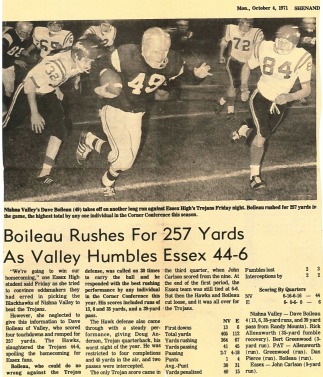 On Friday, Oct. 1, 1971, a call from an Essex High School student, Mimi Johnson, provided the most important reader feedback of Buttry’s career. She faulted his prediction that Nishna Valley would beat Essex in that evening’s game. Nishna Valley won, 44-6. Buttry and Johnson later met in person and started dating. They would be married for more than 42 years.
After graduating from Shenandoah High School in 1972, Buttry went to Texas Christian University on a National Merit Scholarship. He immediately started writing as a reporter for the student newspaper, The Daily Skiff. Buttry worked for the Skiff throughout his time at TCU, including two semesters as editor-in-chief.
The Buttry-Johnson romance continued when he went to Texas. They married Aug. 3, 1974, at St. Mary’s Catholic Church in Shenandoah and lived in off-campus housing his junior and senior years.
Upon graduation from TCU in May of 1976, Buttry returned to Shenandoah as a news reporter for the Sentinel. He later added the duties of editorial page editor and managing editor.
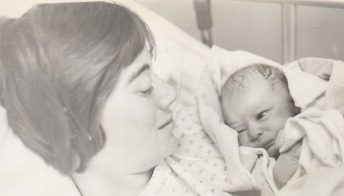
Mimi Johnson Buttry with the couple’s oldest son, Mike, shortly after birth.
Also in 1976, Mimi gave birth to their first son, Michael Wesley Buttry, born Dec. 10.
Buttry accepted a job as a copy editor for The Des Moines Register in November 1977. Though he would have preferred a reporting job at the time, he was always grateful for learning the fundamentals of journalism as a copy editor. After nearly two years on the copy desk, Buttry moved to the city desk.
The Buttrys’ second and third sons, Joseph Lucas and Thomas Stephen, were born in Des Moines, Joe on Nov. 27, 1980, and Tom on Sept. 15, 1982. Joe was born on Thanksgiving day and Tom was born 10 days before the final edition of the Des Moines Tribune, the sister evening paper to the Register.
The death of the Tribune caused considerable upheaval in the newsroom, including 15 early retirements and 55 more job cuts, but Buttry received both a pay raise and a promotion, to the chief assistant city editor, known in the newsroom as the “hot seat.” He confessed later to feeling some “survivor’s guilt” over his good fortune at a time when others were losing their jobs.
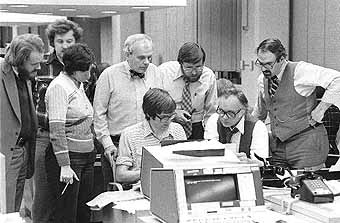
Steve Buttry, seated at computer terminal, got help on deadline in covering the 1980 Republican caucuses.
He played key editing roles in coverage of both the 1980 and ’84 Iowa caucuses. In 1983, he created “The Iowa Caucus Game,” a board game that celebrated and spoofed the quadrennial political spectacle (and the Register’s role in covering it). One of his family’s favorite photos shows Steve on caucus night in 1980, as the Register was preparing to call George H.W. Bush the winner. Top editors and reporters huddled around Buttry at an old computer terminal as he edited the story.
In 1980 and ’85, Buttry got his first experiences in two pursuits that would later become the primary focus of his career: teaching and newsroom training. He spent two winter quarters (1980-81 and ’83-84) as an adjunct journalism teacher at Central College in Pella, Iowa, and in early 1985 he spent two days visiting the St. Joseph News-Press and Gazette, in St. Joseph, Mo., as a writing coach.
In 1984, Buttry decided he wanted to move from editing to reporting. Managing Editor Arnold Garson accommodated, making Buttry a general assignment reporter covering news around Iowa. After just a few months, though, Garson had another assignment for Buttry: launching Hometown, a regional weekly section of the Register to be based in Fort Dodge, Iowa. After a successful launch of Hometown, Buttry was assigned to spend a few weeks in Mason City, Iowa, helping fine-tune the regional news operation there.
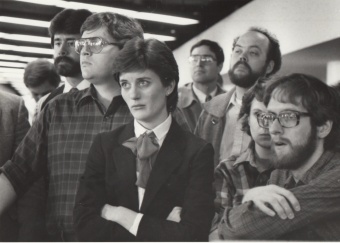
The Register newsroom learns that Gannett is buying the company, 1985. Steve Buttry is at the far right.
In March 1985, shortly after the sale of the Register to Gannett Corp. Buttry accepted an offer to become assistant national/mid-America editor at the Times, and two years later, Buttry was named to replace Rick Tapscott as national/mid-America editor.
After the evening Star and morning Times announced they would “merge” in 1990, producing a morning paper called the Star. Buttry initially was assistant managing editor/national and mid-America for the new paper, but eventually spent his last six months there as an agri-business reporter.
In July 1992, Buttry accepted the job of editor of the Minot Daily News in North Dakota, where he oversaw the newspaper’s conversion from evening to morning publication. He also got to live out every journalist’s dream of shouting, “Stop the presses!” in response to a late-breaking story, and saw his wife Mimi gain considerable local popularity as a columnist and freelance writer.
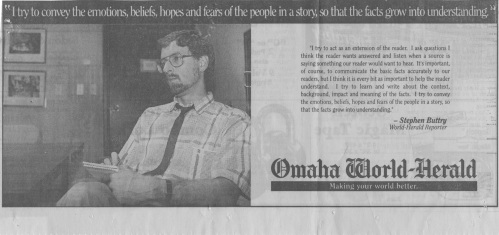
A World-Herald house ad promotes Buttry’s work.
During his time at the World-Herald in the 1990s he started learning and practicing the skills of digital journalism and he actively promoted himself as a newsroom trainer, setting the course for his later career as he continued as a reporter.
In 1997, after returning from a National Writers Workshop in the Twin Cities, Buttry decided he knew as much about journalism as the veteran editors and reporters who led sessions at the workshop and decided to seek business visiting newsrooms and journalism conferences to lead workshops on various reporting and editing skills. He decided on a few topics for workshops, developed a promotional flier and sent it out to newsrooms and press associations around the Midwest. His first client was the York News-Times in York, Neb. The North Dakota Newspaper Association also invited him up to Bismarck for a conference, and he arranged a visit to his former newsroom in Minot as part of the trip.
Rick Tapscott, the editor who hired Steve in 1985, recruited Buttry back to Des Moines as religion reporter and writing coach, including his first weekly column.
Buttry’s first cancer diagnosis came in 1999, which was quickly treated with surgery.
In early 2000, Buttry again was involved in coverage of the Iowa caucuses, including a story that generated some national attention about the role of religion in the caucuses.
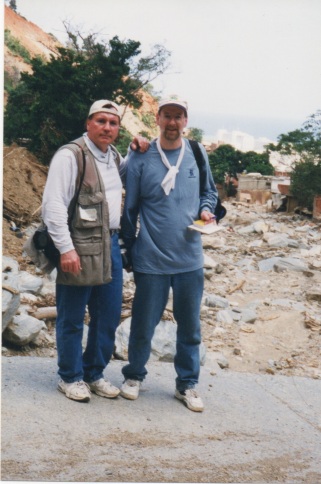
Gary Fandel and Steve Buttry on assignment in Venezuela.
Buttry’s biggest foreign reporting assignment came during his second hitch at the Register. First Assembly of God, one of Des Moines’ biggest churches, sent a mission group to Venezuela following a mudslide disaster there. Buttry persuaded Tapscott to send him along for the nine-day trip, along with photojournalist Gary Fandel.
In May 2000, Buttry agreed to return to the World-Herald as national correspondent and writing coach. The World-Herald agreed to let him train at other newspapers using vacation time and to use company time to speak to non-paying conferences at journalism organizations and press associations. Buttry spoke extensively, building an international reputation as a newsroom trainer.
At this time Buttry also joined a major newsroom trainer projects, the launch of the No Train, No Gain website to share newsroom training materials with colleagues around the world. Buttry quickly volunteered to be content coordinator for the website and posted all of his own workshop handouts on the site. He eventually added a blog about training issues, called Training Tracks.
Buttry credited NTNG with spreading his reputation as a leading newsroom trainer, and he soon was visiting several newsrooms a year to present workshops for journalists as well as training for state and regional press associations, universities and other journalism organizations.
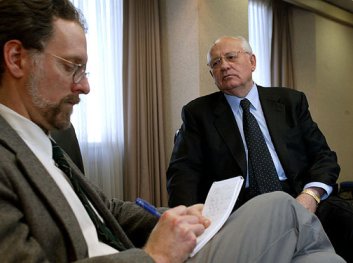
Steve Buttry interviews Mikhail Gorbachev. Photo by Kent Sievers.
Stories that dominated Buttry’s reporting in the 2000s included 9/11, the University of Nebraska at Omaha’s involvement in Afghanistan, sexual abuse by priests and a former Boys Town counselor and Omaha’s Sudanese refugee community. He also interviewed former Soviet President Mikhail Gorbachev in 2002. Buttry’s seventh time covering the Iowa caucuses included coverage of a 2004 Democrautic caucus in Council Bluffs.
The Buttry family began growing in the same decade. Mike married Susie Burke in 2003, Joe married Kim Bagby in 2007 and Tom married Ashley Douglass in 2015.
In April 2005 Buttry took a new job as director of tailored programs at the American Press Institute. At API, he worked in the Newspaper Next project, which sought to lead the industry in development of new business models.
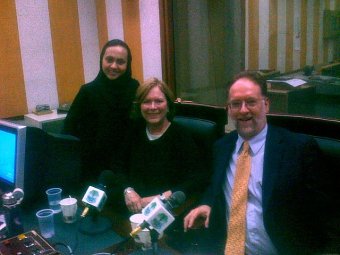
Carol Ann Riordan, center, and Steve Buttry in a radio studio following an interview on their visit to Saudi Arabia.
He wrote his first draft of a business model called A Blueprint for the Complete Community Connection while at API, proposing it as part of the Newspaper Next 2.0 report. When API decided not to include C3 in the 2.0 report, Buttry began looking for a company interested in trying the approach.
Buttry thought he had found the right home to try C3 when he accepted the job of editor of the Cedar Rapids Gazette and Gazetteonline.com (now thegazette.com). The situation at the Gazette changed dramatically Buttry’s third day as editor, June 12, 2008, when Cedar Rapids was inundated by a historic flood.

The Gazette‘s 12-column wrap-around front page on June 13, 2008.
Buttry was always proud of his staff’s excellent flood coverage, but the company’s interest in his new approach to business started waning almost immediately. What seemed like a perfect fit in May 2008 had turned into a miserable situation a year later, and Buttry was looking for his next job.
He blogged frequently, though, about issues relating to digital journalism and business models to sustain it. The blog, which he eventually called The Buttry Diary, was where he published his C3 Blueprint and a call for news organizations to pursue mobile-first strategy. The ideas drew international attention, including an invitation to teach about C3 in Siberia.
Buttry became one of journalism’s busiest bloggers, especially considering his job was never full-time blogging. In addition to the journalism blog, he launched a baseball blog, Hated Yankees, in 2009, and a travel blog, with his wife, 2 Roads Diverged, in 2012. After Mimi published her journalism novel, Gathering String, in 2012, Buttry also published a blog promoting the book. He was a regular contributor to the International News Media Association’s Culture Change blog in 2014 and a guest contributor to still more journalism blogs.
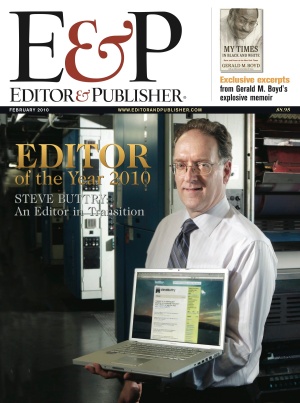 Buttry’s performance in Cedar Rapids earned him recognition from Editor & Publisher magazine as Editor of the Year. The award praised the vision outlined in C3.
Fittingly, that next job was with someone Buttry knew only digitally before they met to discuss the job, Jim Brady, former executive editor of washingtonpost.com. Brady and Buttry followed each other on Twitter and were scheduled to be on a panel together at the University of Missouri in November 2009. The month before, Brady announced that he was launching a new venture covering local news in the Washington area for Allbritton Communications, owner of Politico as well as two Washington TV stations. Buttry messaged Brady that he’d like to be involved and they agreed to talk in Columbia. By February 2010, Buttry was moving to Washington to lead community engagement for the venture, which they eventually named TBD.
While in the Washington area, Buttry taught as adjunct faculty at graduate programs at Georgetown and American universities.
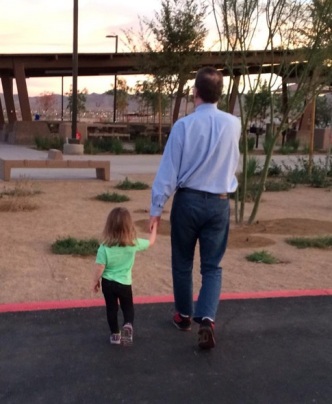
Madeline and Gramps at the park.
Buttry also became a grandfather in 2010 while in Washington, waiting at the hospital for the birth of Mike and Susie’s daughter, Julia. Buttry was a doting grandfather, known as Gramps to Julia and her sister, Madeline, born in 2012 in Edina, Minn.
Though TBD’s launch attracted considerable attention (Buttry was in charge of media relations, among other things), Brady lost an internal battle for control of the operation and left just three months after TBD launched. Brady landed quickly with the Journal Register Co., whose CEO, John Paton, wanted to transform how newspapers thought and operated. Brady soon hired Buttry to help him lead newsrooms at JRC, which became Digital First Media and took over operations of the former MediaNews Group.
Buttry visited the newsrooms of all DFM daily newspapers, visiting some of them in multiple locations as newsrooms moved as well as some weekly newsrooms. In all, he visited 84 DFM newsrooms, leading workshops for staffs as well as coaching editors and other staff members. Two primary focuses of his work at DFM were training new editors in leading Digital First newsrooms and “unbolting” newsroom culture from the newspaper factory model.
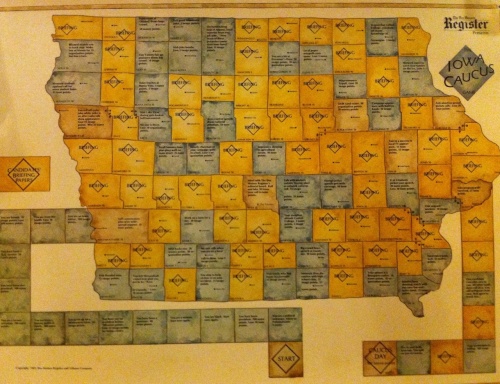
Iowa Caucus Game, 1983
The DFM experience ended when the hedge fund that controlled DFM, Alden Global, changed its strategy. Buttry’s job was cut April 2, 2014, along with other members of the company’s Thunderdome newsroom. Brady and Paton eventually left DFM as well.
The day of the Thunderdome cuts, Dean Jerry Ceppos of LSU’s Manship School of Mass Communication offered Buttry a job as Lamar Visiting Scholar. Buttry eventually accepted the job and moved full-time into academia. After initially accepting a one-year position, Buttry became the director of Student Media in 2015.
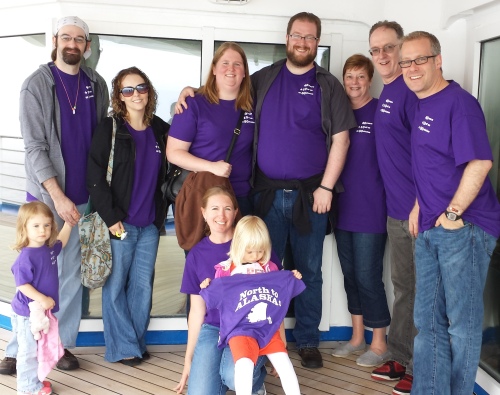
Family photo on the Alaska cruise. Standing from left, Madeline, Joe, Kim, Ashley, Tom, Mimi, Steve, Mike. In front, Susie and Julia.
Before starting the LSU job, the Buttry sons and their wives took Steve and Mimi on an Alaska cruise to celebrate their 40th wedding anniversary in August 2014, taking Buttry to his 50th state. After cruising with the whole family from Vancouver to Anchorage, the couple continued alone on a trip to Denali National Park, where they saw both clear views of the highest U.S. mountain peak, which is often shrouded in clouds, and the big-game “grand slam” of wolves, grizzly bears, moose, caribou and Dall sheep.
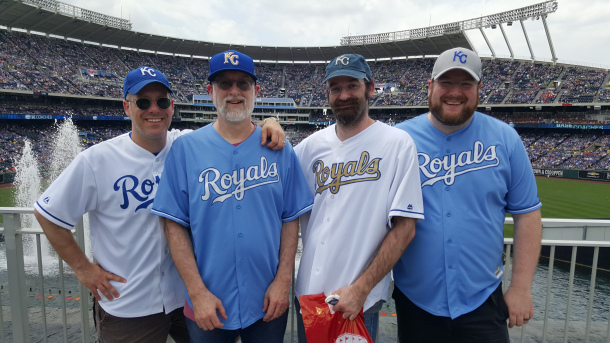
Another family highlight followed later in 2014, when Buttry kept a 29-year-old promise, made when he took Mimi to Game Two of the 1985 World Series. That was the Buttrys’ first year in Kansas City, and Buttry promised to take Mike the next time the Royals were in the World Series. The Royals didn’t return to the Series again until 2014, when Buttry kept his promise to Mike and took Joe and Tom to the game for good measure.
The next month, a pain in Buttry’s back and a lump in his left armpit led to a series of tests that diagnosed mantle-cell lymphoma. Chemotherapy and related medical problems, including a craniotomy to drain bleeding in his brain, took up most of 2015. However, Buttry was able to travel to Maryland to keep another vow to dance at Tom and Ashley’s wedding. The lymphoma treatment concluded with a stem-cell transplant, using Buttry’s own cells, in December 2015.
Toward the end of the stem-cell transplant recovery, Buttry received a message that provided a journalism highlight for 2016. Bridget Hegarty, a source from a 1996 story, tracked him down to thank him:
You helped give what happened to me a voice. It was a voice that I can now use, and do use every day of my life. You gave my voice confidence and reassurance when I thought that part of me was gone forever. I have always wanted to thank you for that!
Buttry used the experience to write an article for Columbia Journalism Review on the journalistic principle of “giving voice to the voiceless.”
Soon Buttry’s focus returned to medical matters, though. A routine follow-up scan in April detected problems in the pancreas and subsequent tests diagnosed him with pancreatic cancer, unrelated to the earlier cancers. Later tests showed the tumor was not responding to chemotherapy and had spread to the liver.
Buttry was honored for his contributions to journalism with three major awards in his final years: the Glamann Award from the American Copy Editors Society in 2015, the Rich Jaroslovsky Founder Award from the Online News Association in 2016 and the Chairman’s Citation from the National Press Foundation in 2017. He also will be honored with The Steve Buttry College Journalism Award by The Fourth Estate Public Benefit Corporation and the creation of the Stephen Buttry Scholarship at the Manship School. He was recognized in 2010 as a member of the Hall of Excellence at TCU’s Schieffer School of Journalism.
Buttry is survived by his wife, Mimi Johnson Buttry; sons Mike, Joe and Tom; daughters-in-law Susie Burke, Kim Bagby and Ashley Douglass; granddaughters Julia Burke Buttry and Madeline Burke Buttry; mother Harriet Buttry of Lee’s Summit, Mo.; brothers Dan of Hamtramck, Mich.; and Don of Shenandoah, Iowa; sister Carol Devlin of Bolton, Vt.; and many in-laws, nieces and nephews.
— 30 —
 In addition, we’ll discuss these ethics projects:
 Still another highlight of the year was when
  Mimi had a productive year in writing and with the needle. She got a good freelance gig for much of the year, writing questions for the weekly news quiz that was part of
 Twenty-five years ago, I crowdsourced the Minot Daily News’ coverage of the 50th anniversary of the attack on Pearl Harbor.


 The Buttry Diary